
Shraddha is one of the most sacred observances in Sanatan Dharma, performed during Pitru Paksha (Shraddha fortnight). It is the time when we remember and honour our ancestors (Pitras) with gratitude. Scriptures say that when Shraddha is performed with sincerity, the souls of our forefathers are satisfied, they bless us, and obstacles in life reduce.
But many people also hear about Pitra Dosha and wonder what it is, why it occurs, and how Shraddha can help remove it. This article explains Pitra Dosha, Shraddha rituals, remedies for all, and the most sacred places in India (including Gujarat) where Pitru rituals like Narayan Bali and Tripindi Shraddha are performed.
Table of Contents
ToggleWhat is Pitra Dosha?
Pitra Dosha is not a curse, but a karmic imbalance in the family lineage. It arises when:
- Ancestors have unfulfilled desires.
- Proper Shraddha or Tarpan has not been performed for generations.
- A person in the family died unnaturally, suddenly, or without proper rites.
- Astrological combinations such as Sun/Rahu/Ketu affliction, or 9th house weakness, appear in the chart.
Effects of Dosha:
- Delay in marriage, or repeated marital issues.
- Difficulty in conceiving or problems with children.
- Financial instability, losses, or lack of growth.
- Family disputes and disharmony.
- Recurring obstacles in career, education, or health.
Why Shraddha is Performed
The Garuda Purana and Mahabharata explain that Shraddha gives nourishment to Pitras in their subtle body. A famous story is of Karna, who after death received gold and silver in Pitruloka but no food. He was allowed to return to Earth for 15 days to perform Shraddha, and this became the basis of Pitru Paksha.
Thus, Shraddha is our way of saying “Thank You” to our ancestors. When they are satisfied, their blessings remove Pitru Dosha and bring peace, prosperity, and protection to the family.
Rituals of Shraddha (Step-by-Step)
- Purification → Bath and clean clothes.
- Sankalp → Remember ancestors up to seven generations (both paternal & maternal).
- Tarpan → Offer water, black sesame, barley, and kusha grass with mantras.
- Pind Daan → Rice balls mixed with honey, ghee, and sesame offered with devotion.
- Brahman Bhojan → Feeding Brahmins or needy people.
- Feeding Cows, Crows & Dogs → Symbolic carriers of offerings to Pitras.
- Charity (Daan) → Donation of food, clothes, or essentials in their memory.
Simple Remedies for Everyone During Shraddha
Not everyone can do full rituals, but even small acts with faith work powerfully:
- Offer water with black sesame to the Sun every morning.
- Light a ghee lamp in the South direction (Pitru direction).
- Feed stray animals, especially cows, dogs, and crows.
- Cook kheer, dal, or rice and donate to the poor.
- Offer water under a Peepal tree with a diya.
- Chant “Om Pitrubhyo Namah” or Gayatri Mantra.
Vastu Remedies for Pitra Dosha
- South-West (Pitru Sthaan) of the house must be strong, heavy, and clean.
- Keep ancestors’ photographs in South-West facing North-East.
- Light a diya daily in this area during Pitru Paksha.
- Avoid toilets, dust, or broken items in South-West zone.
This is the same zone associated with ancestral energy in Vastu overall — see our detailed guide on why a kitchen placed in the South-West disturbs ancestral peace and wealth for a deeper look at this direction.
Special Rituals: Narayan Bali & Tripindi Shraddha
Some karmic conditions need special ancestral rituals performed at holy tirthas:
Narayan Bali
- Purpose: To free souls who died unnatural, sudden, or premature deaths.
- Places: Trimbakeshwar (Maharashtra), Gokarna (Karnataka).
Tripindi Shraddha
- Purpose: For neglected Shraddha across three or more generations.
- Places: Trimbakeshwar, Gaya (Bihar), Pandharpur (Maharashtra).
Sacred Places in India for Shraddha & Pitra Tarpan
- Gaya (Bihar) → Holiest place for Pind Daan. Lord Rama did Shraddha for Dasharatha here.
- Trimbakeshwar (Maharashtra) → Famous for Narayan Bali & Tripindi Shraddha.
- Siddhpur (Gujarat) → Known as Matru Gaya — especially for maternal ancestors.
- Chanod / Chandod (Gujarat) → On the banks of Narmada River near Dabhoi. One of Gujarat’s most important Pitru-tirths. Families come here for Shraddha, Pind Daan, and Pitru Tarpan, especially for removal of Pitra Dosha.
- Prayagraj (Uttar Pradesh) → At Triveni Sangam of Ganga, Yamuna, Saraswati.
- Varanasi (Uttar Pradesh) → City of liberation; Shraddha ensures moksha.
- Haridwar (Uttarakhand) → Shraddha on Ganga ghats at Har Ki Pauri.
- Badrinath (Uttarakhand) → Brahma Kapal ghat is highly auspicious.
- Pushkar (Rajasthan) → Sacred Pushkar lake, near Brahma temple.
- Rameswaram (Tamil Nadu) → Considered the “Gaya of South India.”
- Gokarna (Karnataka) → Coastal tirtha for Narayan Bali.
Benefits of Performing Shraddha
- Peace to ancestral souls.
- Removal of Pitra Dosha and obstacles.
- Family harmony and protection.
- Growth in career, wealth, and health.
- Blessings for children and future generations.
Final Note
Shraddha is not about fear, it is about gratitude and connection. Even a simple act of offering water with devotion during Pitru Paksha can bring immense blessings. For stronger karmic debts, rituals like Narayan Bali and Tripindi Shraddha at sacred places like Gaya, Trimbakeshwar, Siddhpur, Chanod, Rameswaram hold immense power.
By remembering our Pitras, we free them and free ourselves — turning karmic debts into divine blessings.
Frequently Asked Questions – Pitra Dosha & Shraddha
1. पितृ दोष क्यों होता है?
पितृ दोष तब बनता है जब पूर्वजों की आत्माएँ तृप्त नहीं होतीं, श्राद्ध या तर्पण अधूरा रह जाता है, या परिवार में अकाल मृत्यु हुई हो। ज्योतिष अनुसार, यदि सूर्य, राहु, केतु या शनि नवम भाव को प्रभावित करते हैं तो कुंडली में पितृ दोष दिखाई देता है।
2. पितृ दोष के लक्षण क्या हैं?
- विवाह में बार-बार रुकावट
- संतान सुख में बाधा
- आर्थिक परेशानी और कर्ज
- घर में कलह और असामंजस्य
- अचानक दुर्घटना या स्वास्थ्य समस्या
3. पितृ दोष को दूर करने के उपाय क्या हैं?
- श्राद्ध, तर्पण और पिंडदान करना
- पितृ पक्ष में ब्राह्मण, गरीब और गौ सेवा
- पीपल के पेड़ के नीचे दीपक जलाना और जल अर्पण करना
- नर्मदा, गंगा या अन्य पवित्र नदियों में पितृ तर्पण करना
- नारायणबली और त्रिपिंडी श्राद्ध जैसे विशेष कर्म कराना
4. श्राद्ध कहाँ कराना सबसे पवित्र माना गया है?
भारत के प्रमुख पितृ तीर्थ स्थल हैं:
- गया (बिहार) – पिंडदान के लिए सर्वोत्तम
- त्र्यंबकेश्वर (नाशिक, महाराष्ट्र) – नारायणबली और त्रिपिंडी श्राद्ध
- सिद्धपुर (गुजरात) – मातृगया (माता पक्ष हेतु)
- चनोड / चंदोद (गुजरात) – नर्मदा नदी के किनारे श्राद्ध व पितृ तर्पण
- प्रयागराज, वाराणसी, हरिद्वार, रामेश्वरम आदि
5. क्या घर पर भी श्राद्ध किया जा सकता है?
हाँ, यदि तीर्थ यात्रा संभव न हो तो घर पर भी श्रद्धा और मंत्रों से तर्पण किया जा सकता है। पानी में काले तिल, कुश और अक्षत डालकर पितरों को अर्पित करना अत्यंत शुभ फल देता है।
6. पितृ दोष जानने और सही उपाय के लिए किससे सलाह लें?
आप अपनी कुंडली की जांच करवाकर पितृ दोष की स्थिति जान सकते हैं। Astrologer Ashish Somani, Best Astrologer & Vastu Consultant in Ahmedabad, Gujarat, आपकी जन्म कुंडली देखकर सही उपाय बता सकते हैं।
Frequently Asked Questions (FAQ)
What is the astrological combination for love at first sight?
Can friendship slowly turn into love according to astrology?
Why do some people take years to fall in love?
How does astrology explain karmic or past-life love?
Can astrology show love through career or workplace?
What are the astrological yogas for love through arts, music, and creativity?
Which astrological placements show intense or risky love?
How can astrology indicate love in foreign lands?
Not Sure If Pitra Dosha Is Affecting Your Family?
A detailed birth chart review can reveal whether Sun, Rahu, Ketu, or Saturn are afflicting your 9th house — and which remedy suits your specific situation. Astrologer Ashish Somani can guide you through the right rituals and corrections.
What is Pitra Dosha in astrology?
Pitra Dosha refers to disturbances in ancestral lineage seen when the Sun, the 9th house, or their lords are afflicted by Rahu, Ketu or Saturn.
Can ancestral experiences affect future generations?
Modern science suggests environmental stress or trauma may influence gene expression through epigenetics, which may affect future generations.
What are the remedies for Pitra Dosha?
Traditional remedies include Pitra Tarpan, Shraddha rituals, Surya worship, charity and Narayan Bali performed at sacred places like Chanod or Trimbakeshwar.
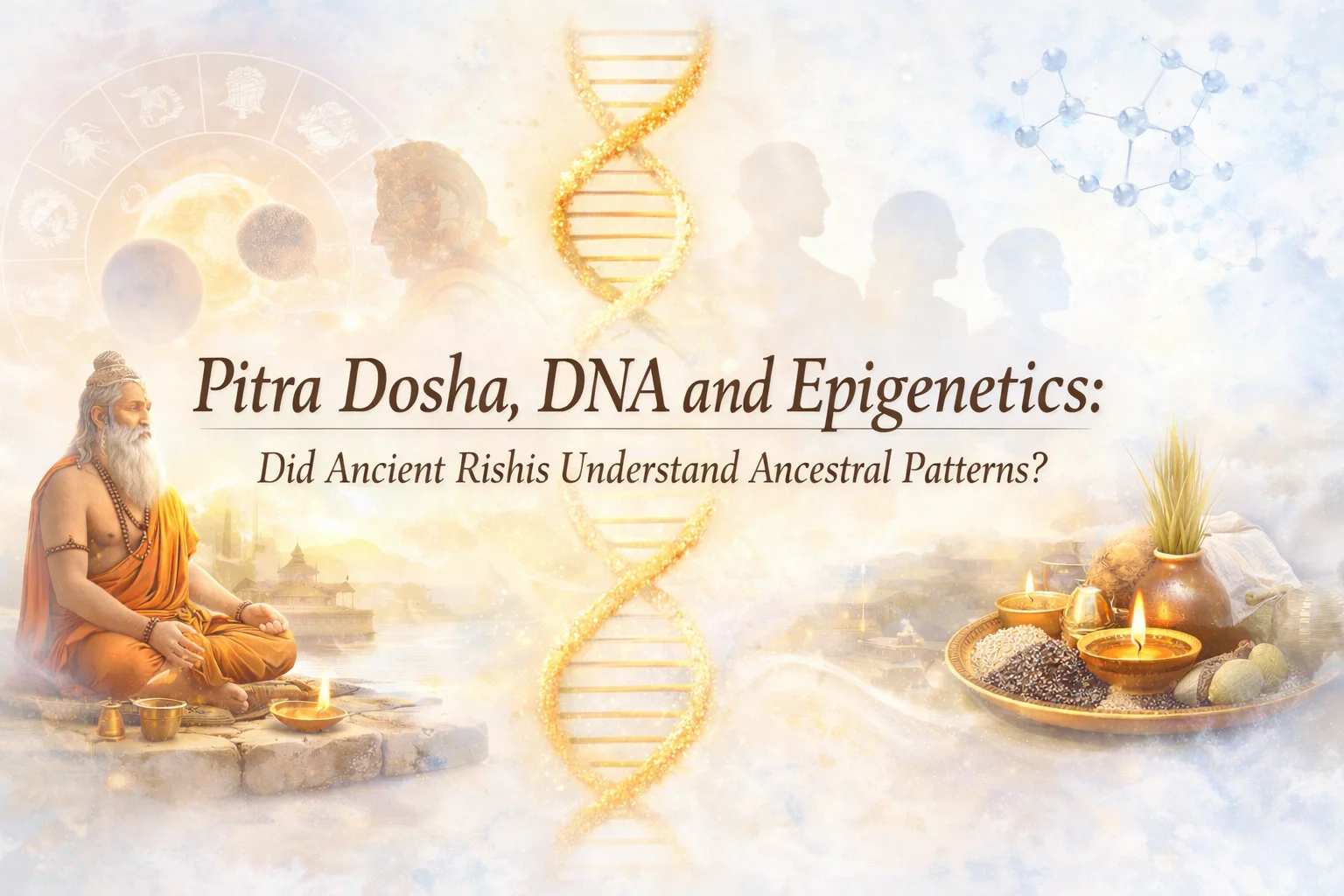
Could ancient sages have symbolically described ancestral patterns that science is now beginning to explore?
Let us understand this step by step.
What is DNA and Gene?
Every human body contains DNA, which is the instruction manual of life.
Each cell in the human body contains:
- 46 chromosomes
- 23 from father
- 23 from mother
These chromosomes carry thousands of genes.
Genes determine many biological tendencies such as:
- body structure
- metabolism
- hormone balance
- disease risk
- brain chemistry
But genes alone do not decide everything.
The way genes behave or activate is equally important.
What is Gene Expression?
Not every gene in your body is always active.
Some genes are:
- ON (active)
- OFF (inactive)
This process is called gene expression.
Example: A person may carry a gene linked with diabetes, but if that gene remains inactive, the disease may never appear.
Gene expression is influenced by:
- diet
- stress
- lifestyle
- environment
- emotional experiences
This is where a fascinating field of science comes in.
What is Epigenetics?
Epigenetics studies how external factors change the activity of genes without changing the DNA itself.
Think of DNA as a book and epigenetics as bookmarks that decide which chapter will be read.
Factors that can affect gene expression include:
- chronic stress
- trauma
- pollution
- nutrition
- emotional environment
These changes sometimes leave chemical marks on DNA called epigenetic markers.
In certain cases, these markers may influence the next generation.
Transgenerational Epigenetic Inheritance
Real Scientific Research on Ancestral Influence
One of the most famous studies is the Dutch Hunger Winter (1944–45).
During World War II, severe famine struck the Netherlands.
Researchers later studied children who were in their mother’s womb during this famine.
They found:
- higher risk of diabetes
- higher obesity rates
- cardiovascular issues later in life
Scientists discovered epigenetic changes in growth-related genes (IGF2 gene) in these individuals.
This suggested that environmental stress experienced by one generation could affect gene expression in future generations.
Another experiment at Emory University showed that mice trained to fear a specific smell passed that fear response to their offspring, even when the offspring had never experienced the shock themselves.
This suggests that ancestral experiences may influence biological responses.
Ancient Wisdom: The Concept of Pitra Dosha
In Vedic astrology, the concept of Pitra Dosha refers to disturbances related to the ancestral lineage.
The word Pitra means ancestors or forefathers.
According to classical Jyotish principles inspired by Maharishi Parashara, ancestral influences are seen mainly through:
- Sun (Surya) – karaka for father and lineage
- 9th house – house of ancestors and dharma
- Rahu/Ketu – karmic disturbances or eclipsing forces
When these factors are afflicted, astrologers interpret it as Pitra Dosha.
Common Astrological Combinations for Pitra Dosha
Some typical combinations considered indicators include:
- Sun conjunct Rahu
- Sun conjunct Ketu
- Rahu placed in the 9th house
- Saturn influencing the 9th house strongly
- Sun severely afflicted in the chart
- Eclipse combinations involving Sun or Moon
These combinations symbolically suggest disturbance in paternal lineage energy.
Possible Life Patterns Observed
People with strong ancestral affliction patterns may experience:
- delay in career success
- repeated financial instability
- conflicts with father or authority figures
- relationship problems
- sudden obstacles despite effort
In traditional astrology, these patterns are interpreted as ancestral imbalance or unresolved lineage karma.
Traditional Remedies for Pitra Dosha
Vedic tradition prescribes certain rituals to restore ancestral harmony.
Some common remedies include:
1. Pitra Tarpan
Offering water with sesame seeds while remembering ancestors.
Purpose: expressing gratitude and honoring lineage.
2. Shraddha Rituals
Performing annual ancestral offerings during Pitru Paksha.
Purpose: symbolic nourishment and remembrance of ancestors.
3. Narayan Bali Ritual
Performed in sacred places like Chanod (Narmada), Gokarna or Trimbakeshwar.
This ritual is traditionally recommended when there are strong indications of ancestral unrest.
4. Surya Remedies
Because Sun represents father lineage.
- offering water to the Sun
- Sunday charity
- respecting father and elders
How Can These Remedies Work?
From a traditional belief perspective:
Ancestor imbalance
↓
Ritual offering
↓
Pitra shanti
↓
Blessings restored
But there can also be practical explanations.
Psychological and Behavioral Impact
Rituals often create:
- emotional closure
- gratitude toward ancestors
- family unity
- reduction in guilt or resentment
This can improve mental clarity and decision making.
Better mental state → better life choices.
Environmental and Lifestyle Changes
After performing remedies people often:
- adopt disciplined routines
- engage in charity
- reconnect with family values
These lifestyle changes can positively affect:
- stress levels
- health habits
- emotional stability
Lower stress can indirectly influence gene expression through epigenetic mechanisms.
Integrating Science and Spiritual Insight
We should not claim that astrology literally changes DNA.
However, both ancient wisdom and modern science acknowledge one truth:
Our ancestors influence us in multiple ways.
- biology
- upbringing
- emotional patterns
- cultural values
Ancient sages described it through karma and Pitra Dosha.
Modern science studies it through genetics and epigenetics.
Final Thoughts
Pitra Dosha may be understood as a symbolic representation of ancestral patterns affecting present life.
While astrology uses planetary language, science uses biological terminology.
We are deeply connected to our lineage.
Honoring ancestors, living with discipline, and maintaining emotional balance can help restore harmony.
For a detailed Pitra Dosha analysis of your birth chart, consult a top astrologer in Ahmedabad who can decode your ancestral planetary patterns.
Frequently Asked Questions (FAQ)
1. What is Pitra Dosha in astrology?
Pitra Dosha in Vedic astrology refers to disturbances related to ancestral lineage. It is usually observed when the Sun, the 9th house or their lords are afflicted by Rahu, Ketu or Saturn.
2. What are the common signs of Pitra Dosha in life?
- repeated career obstacles
- delay in marriage
- financial instability despite effort
- conflicts with father
- recurring family problems
3. What planetary combinations indicate Pitra Dosha?
- Sun conjunct Rahu
- Sun conjunct Ketu
- Rahu in 9th house
- afflicted 9th lord
- eclipse combinations
4. What is the connection between epigenetics and ancestral patterns?
Epigenetics studies how environmental factors influence gene activity across generations.
5. What is Narayan Bali?
A ritual performed to resolve ancestral disturbances.
6. How does Pitra Tarpan help?
It honors ancestors and restores blessings.
7. Can honoring ancestors change life outcomes?
It improves emotional balance and decision-making.
8. Is Pitra Dosha permanent?
No, it can be reduced through remedies and lifestyle changes.

