
Camus, Vedanta and Karma: Is the Soul Truly Free?
Quick answer: Camus and Vedanta approach freedom from very different philosophical traditions. This article uses astrology only as a reflective bridge between ideas of karma, meaning and agency; it does not prove a metaphysical claim. For personalised chart interpretation, see Astrology Consultation in Ahmedabad.
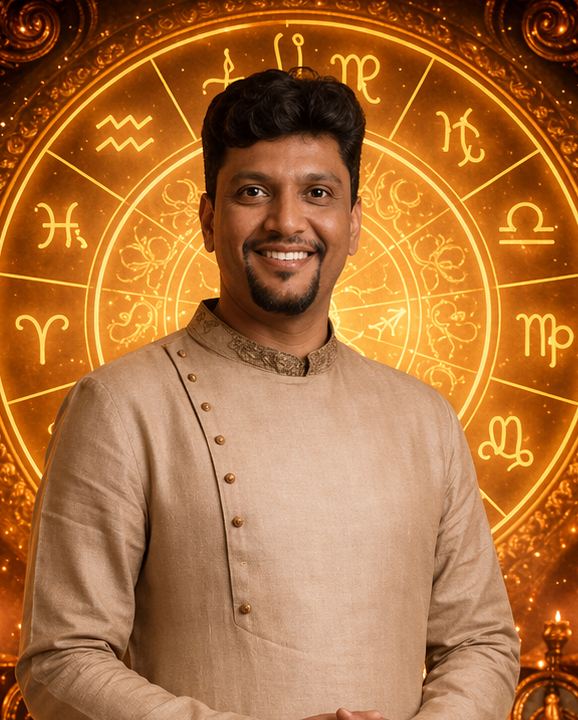
By Astrologer Ashish Somani
Have you ever felt like you’re working hard, trying everything, yet life keeps sending you back to where you started? This cycle is not just emotional—it’s deeply spiritual. In this blog, we’ll explore how the ancient Indian wisdom of Vedanta, the modern philosophy of Albert Camus, and Vedic astrology all connect through one idea: awareness can free you from life’s endless struggle.
👤 Who Was Albert Camus?
He was a French philosopher, writer, and journalist who won the Nobel Prize in Literature in 1957 at the age of 44—making him one of the youngest Nobel laureates in literature. He is best known for his philosophy of the absurd, which explores how human beings search for meaning in a world that offers none.
He believed that life has no inherent meaning, but that doesn’t mean we should give up. Instead, he encouraged people to create their own meaning and live with passion, even in the face of life’s absurd nature. His most famous works include The Stranger, The Myth of Sisyphus, and The Plague.
He was not religious and didn’t believe in karma or divine justice. But he believed deeply in awareness, resilience, and freedom of choice—which makes his ideas surprisingly close to the Indian path of Gyana (knowledge).
Let’s start with a famous story that he used to explain the absurd condition of life.
🪨 The Myth of Sisyphus: A Life of Repetition
Sisyphus was a clever king who tricked the gods. As punishment, they gave him a task:
He must push a huge boulder up a hill, but every time he reaches the top, the boulder rolls down. He must start over. Forever.
To philosopher Albert Camus, this myth was a symbol of our daily lives—where we work, struggle, and often feel like nothing changes. But Camus believed that the moment we become aware of this pattern, and still choose to go on, we find freedom.
“The struggle itself toward the heights is enough to fill a man’s heart. One must imagine Sisyphus happy.”
🕉 Vedanta’s Wisdom: You Are Not the Boulder
In Vedanta, the soul (Atman) is always free. It is the Jeeva—our individual self—that feels stuck in the cycle of birth, death, and karma. Vedanta teaches that the moment we realize we are not the mind or body, but the soul, we become free.
This is called the Gyana Marg—the path of knowledge. It is the same awareness Camus speaks of in modern language.
♻️ Understanding the Three Karmas
Vedic astrology talks about three types of karma:
- Prarabdha Karma – Karma that is already active and must be experienced (your birth, family, major events)
- Sanchita Karma – Stored karma from many past lives, waiting to be released
- Kriyamana Karma – The karma you create every moment by your current actions
These are beautifully symbolized in the myth of Sisyphus:
- 🪨 Prarabdha Karma = The Boulder: You cannot avoid it. You must push through life’s challenges.
- ⛰️ Sanchita Karma = The Hill: The hidden karmic weight shaping your life’s path.
- 🚶♂️ Kriyamana Karma = The Climb: Your attitude and effort—this is where you can change everything.
“The soul is always free. It’s your awareness that brings liberation.”
🪐 The Role of Rahu and Ketu in Astrology
In Vedic astrology, Rahu and Ketu are shadow planets. They represent deep karmic patterns and spiritual lessons:
- Rahu brings desire, obsession, and confusion.
- Ketu brings detachment, spiritual insight, and sudden endings.
They often lead to experiences that seem unfair or mysterious—but they are meant to push you toward self-awareness.
These planets have no physical form, no houses they rule, and move in reverse. That’s why they represent the absurdity of karma, much like Camus’ view of life.
🔍 How Rahu and Ketu Show Life’s Struggles
- Rahu in the 10th house: You may chase success endlessly and still feel empty. This is the Sisyphus effect.
- Ketu in the 4th house: You may leave your home or emotional comfort, seeking peace elsewhere—only to find that true peace must come from within.
These placements teach you to see beyond the surface and understand your soul’s journey.
🌌 Final Thoughts: You Are Not Stuck
Camus taught that life is hard, but you are free the moment you become aware and choose how to respond. Vedanta teaches that your soul was never truly bound—only your mind was.
Astrology shows you where your boulders are, how steep your hill is, and where your effort (Kriyamana karma) can change your path.
“Rahu and Ketu are not your enemies—they are your teachers. Saturn is not your jailer—he is your guide. And you? You are not the boulder. You are the soul, playing Sisyphus until you wake up and walk with awareness.”
By Astrologer Ashish Somani
Spiritual Guide | Vedic Astrologer | Explorer of Consciousness