
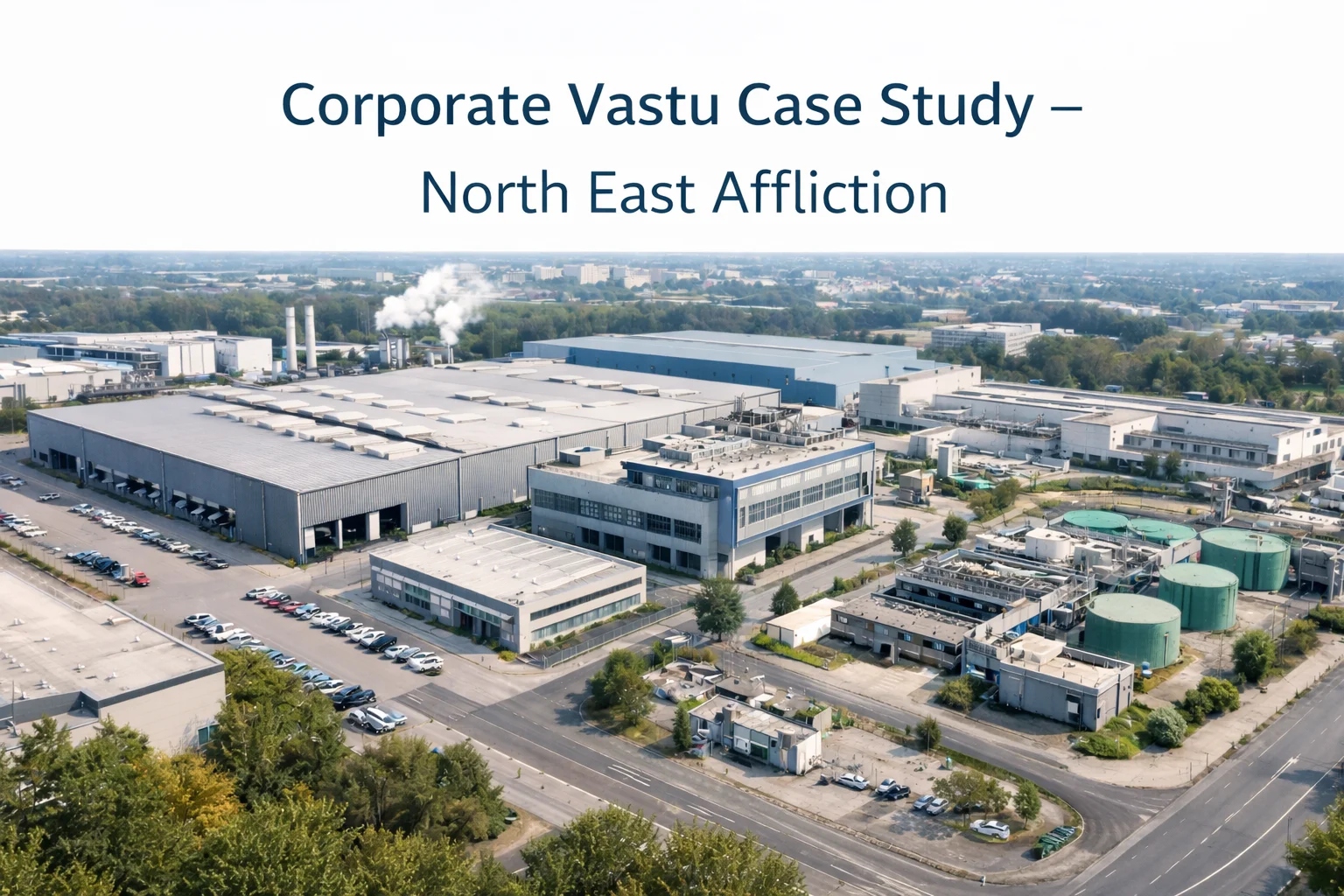
Quick answer: This corporate Vastu case study describes a traditional spatial assessment of North-East use and management seating. It should not be read as proof that Vastu alone caused operational instability or business improvement; management, systems and market factors remain important. For an industrial or office assessment, see Vastu Consultation in Ahmedabad.
Corporate Vastu case study: North-East use and management seating in a manufacturing unit.
Client Profile (Confidential)
- Sector: Manufacturing
- Operations: Plant + Corporate Office
- Status before consultation: Operationally functional but internally unstable
- Nature of engagement: Corporate Vastu Diagnostic & Corrective Implementation
Client identity and exact location withheld for confidentiality.
Business Challenge Faced
Despite stable demand, technical capability, and compliance, the organisation was facing persistent internal instability, reflected as:
- Delayed senior-level decisions
- Execution friction across departments
- Financial pressure without identifiable losses
- High internal stress despite expansion
- Repeated corrective actions with limited long-term impact
The management had already attempted process improvements, restructuring, and technical upgrades, but the problems continued to reappear in different forms.
This indicated a root-level systemic issue, not an operational one.
Scope of Assessment
The assignment covered:
- Manufacturing plant layout
- Corporate office layout
- Leadership & finance seating
- Operational flow & load distribution
The objective was to identify non-technical factors influencing decision flow, stability, and execution rhythm.
Key Findings (Root-Cause Analysis)
1. Severe North-East Affliction at Plant Level
The North-East zone of the manufacturing plant was found to be structurally compromised due to the presence of an Effluent Treatment Plant (ETP).
- The ETP was permanently constructed
- Heavy utilities and pipelines occupied the zone
- The area was blocked, inactive, and non-functional from a directional perspective
Business Interpretation: The North-East governs clarity, guidance, and long-term direction. Placing a waste-handling system here creates continuous internal processing without conclusion.
This explained:
- Why discussions happened but decisions stalled
- Why effort increased but outcomes diluted
2. Structural Nature of the Problem (Why Demolition Was Required)
This issue could not be corrected cosmetically.
- ETP placement was permanent
- Utilities were deeply integrated
- Partial remedies would not neutralise the impact
After detailed discussion with management, relocation of the ETP from the North-East was recommended, even though it involved:
- Partial demolition
- Re-routing of services
- Planned operational adjustments
The recommendation was made after evaluating short-term disruption vs long-term business stability. This is a common pattern in industrial Vastu corrections, where structural utilities need to be relocated rather than symbolically remedied.
3. North-East Affliction at Corporate Office Level
The issue was mirrored at the corporate office.
- North-East zone was blocked and inactive
- No strategic or leadership function was supported here
Combined Effect (Plant + Office): Execution space and decision space were both misaligned, resulting in:
- Continuous activity
- But lack of clarity and confidence at leadership level
4. Incorrect Sitting of Senior Management & Finance Heads
Key decision-makers were seated in pressure-generating zones, leading to:
- Mental fatigue
- Over-analysis
- Delayed approvals
- Excessive review cycles
This had a direct impact on:
- Speed of decisions
- Timing of execution
- Leadership confidence
5. Excessive Static Load on Western Side of the Plant
The western zone of the plant carried:
- High static machinery load
- Concentrated storage
This created:
- Stagnation pressure
- Reduced execution momentum
- Recurrent shop-floor friction
Corrective Measures Implemented
- ETP relocated from the North-East, restoring openness and directional balance
- North-East zones at both plant and office were activated
- Senior management seating was realigned to stability-supporting zones
- Western load distribution was balanced to reduce stagnation pressure
⚠️ This was not a no-disruption project ⚠️ Structural correction was necessary to address the root cause
Post-Implementation Results (3–6 Months)
The organisation reported:
- Faster and clearer decision-making
- Reduced internal friction
- Improved execution rhythm
- Enhanced leadership confidence
- Better control perception over operations and finances
Management feedback:
“Earlier, everything required repeated effort and follow-ups. Now decisions and execution feel more aligned and smoother.”
Why the Improvement Was Sustainable
Because the correction addressed:
- Structural imbalance (ETP relocation)
- Human pressure points (management seating)
- Operational stagnation (load correction)
Not symptoms, but root causes.
Key Learning From This Case
When the North-East is structurally compromised, business keeps functioning — but without clarity.
Some corrections require:
- Investment
- Planning
- Courage
But they prevent long-term stagnation and hidden drain.
Consultant’s Note
This case was handled by Astrologer Ashish Somani, who combines a Chartered Accountancy background with Corporate Vastu expertise, enabling practical, business-oriented decision-making. For a full layout review, a dedicated corporate/commercial Vastu consultation is recommended.
Suitable For
- Manufacturing & chemical plants
- Businesses planning expansion or restructuring
- Organisations facing unexplained stagnation
- Leadership teams under constant pressure
Frequently Asked Questions (FAQ)
Planning a New Plant, Expansion, or Restructuring
Hidden layout defects at the North-East can quietly stall decisions and growth, even when everything looks operationally fine. Get your Plant & Corporate Office Alignment assessed by Astrologer Ashish Somani before investing further capital.
https://astrologerashishsomani.comnal Line (Case Study Closure)
When direction is corrected,
clarity returns before growth does.